

64 Games Super Max Money Cheat
1996 video game
This article is about the original version. For the remake, see Super Mario 64 DS.
1996 video game
| Super Mario 64 | |
|---|---|
 North American cover art | |
| Developer(s) | Nintendo EAD |
| Publisher(s) | Nintendo |
| Director(s) | Shigeru Miyamoto |
| Producer(s) | Shigeru Miyamoto |
| Programmer(s) | Yasunari Nishida Yoshinori Tanimoto |
| Artist(s) | Yoshiaki Koizumi Satoru Takizawa Masanao Arimoto Yōichi Kotabe[4] |
| Composer(s) | Koji Kondo |
| Series | Super Mario |
| Platform(s) | Nintendo 64, iQue Player |
| Release | Nintendo 64
|
| Genre(s) | Platform |
| Mode(s) | Single-player |
Super Mario 64 [a] is a 1996 platform game for the Nintendo 64 and the first Super Mario game to feature 3D gameplay. It was developed by Nintendo EAD and published by Nintendo. Super Mario 64 features 3-dimensional freedom of movement within a large open world based on 3D polygons. It builds upon the Mario tradition of gameplay elements, visual style, and characters. As Mario, the player explores Princess Peach's castle to rescue her from Bowser.
Director Shigeru Miyamoto conceived a 3D Mario game during the production of Star Fox (1993). Development lasted approximately three years: one on design and two on production. The high-fidelity graphics were created using the Nichimen N-World toolkit. The score was composed by Koji Kondo. A multiplayer mode featuring Mario's brother Luigi was cut, but rumors spread of his inclusion as a hidden character. As one of the launch games for the Nintendo 64, Super Mario 64 was released in Japan on June 23, 1996, and later in North America and Europe in September 1996 and March 1997, respectively.
Featuring a dynamic camera system and 360-degree analog control, it established a new archetype for the 3D genre, much as Super Mario Bros. did for side-scrolling platform games. Super Mario 64 received critical acclaim as one of the greatest video games of all time. Reviewers praised its ambition, visuals, gameplay, and music, although some called the camera system unreliable. It is the best-selling Nintendo 64 game, with more than eleven million copies sold by 2003. Numerous developers have cited Super Mario 64 as an influence. It was remade as Super Mario 64 DS for the Nintendo DS in 2004, and it has been ported to other Nintendo consoles.
Gameplay

Courses, such as Whomp's Fortress, require the player to navigate chasms.
Super Mario 64 is a 3D platform game in which the player controls Mario through various courses. Mario's abilities in Super Mario 64 are far more diverse than those of previous Mario games.[5] [6] The player can make Mario walk, run, jump, crouch, crawl, climb, swim, kick, grab objects, or punch using the game controller's analog stick and buttons. Special jumps can be executed by combining a regular jump with other actions, including the double and triple jumps, long jump, backflip, and wall jumping to reach high areas.[7] [8] Super Mario 64 is the second mainline Mario game—succeeding Super Mario Bros. 2—to have a traditional health system. The life system from previous Mario games is kept, and Mario loses a life when his health is depleted or if he falls into a bottomless pit. When Mario loses all of his lives, the game ends.[7] [9] Underwater, Mario's health represents how long he can hold his breath, slowly diminishing while underwater and replenishing when he comes back up to the surface.[7] [9]
The hub world takes place in Princess Peach's Castle, which consists of three floors, plus a moat and a courtyard. The player's main objective is to look for paintings that bring them to courses. There are fifteen courses in the game, each with 7 Power Stars. There are also 15 Power Stars hidden as secrets and as bonuses, for a total of 120 Power Stars in the entire game.[10] Each course is an enclosed world in which the player is free to wander in all directions and discover the environment without time limits. The worlds are filled with enemies as well as friendly creatures that provide assistance or ask favors. The player gathers stars in each course; some stars only appear after completing certain tasks, often hinted at by the name of the course. These challenges include defeating a boss, solving puzzles, racing an opponent, and gathering 8 red coins. Collecting stars unlocks more of the castle hub world.[7] [9] Twice in the game, the player unlocks castle doors with keys obtained by defeating Bowser in special courses.[7] Once the player gets at least 70 Power Stars, they can access the final level of the game, blocked by an 'endless staircase'.[11] There are many hidden mini-courses and other secrets within the castle, which may contain extra stars required for the full completion of the game.[10] If the player returns to the game after collecting all 120 Power Stars, Yoshi can be found on the roof of Princess Peach's Castle, who will give the player a message from the developers, accompanied by 100 extra lives.[12] [13]
In absence of the power-ups normally found in previous games, such as the Super Mushroom and Fire Flower, three special cap power-ups appear throughout many stages. The Wing Cap allows Mario to fly after doing a triple-jump or mid-air dive, or being shot from a cannon;[14] the Metal Cap makes him immune to most damage, allows him to withstand wind, perform on-land moves underwater, and be immune to noxious gases; and the Vanish Cap renders him partially immaterial and invulnerable, and allows him to walk through some obstacles.[7] 1-up mushrooms hidden in various places such as trees may chase Mario through the air or else fall to the ground and disappear shortly if not collected.[15]
Plot
The game begins with a letter from Princess Peach inviting Mario to come to her castle for a cake she has baked for him.[16] When he arrives, Mario discovers that Bowser has invaded the castle and imprisoned the princess and her servants within it using the power of the castle's 120 Power Stars. The Power Stars are hidden in the castle's paintings, which are portals to other worlds where Bowser's minions keep watch over the stars. Mario explores the castle for these portals to enter the worlds and recover the stars. He gains access to more rooms as he recovers more Power Stars, and once he gets enough, he breaks the curse of the Endless Stairs that blocked the entrance to the final level of the game. After Mario defeats Bowser in the final battle, he obtains the Jumbo Star which gives him the Wing Cap, and he flies back to the castle. Peach is then released from the stained-glass window above the castle's entrance, and she rewards Mario by kissing him on the nose and baking the cake that she had promised him.[17] [7] [8]
Development

Producer and director Shigeru Miyamoto
In the early 1990s, director and producer Shigeru Miyamoto conceived a 3D Mario design during development of the Super Nintendo Entertainment System (SNES) game Star Fox (1993). He considered using the Super FX chip to develop a SNES game, Super Mario FX, with gameplay based on "an entire world in miniature, like miniature trains".[18] He eventually reformulated the idea for the Nintendo 64, not for its substantially greater power, but because its controller has more buttons for gameplay.[19] According to engineer Dylan Cuthbert, who worked on Star Fox, no game titled Super Mario FX had ever entered development, but rather "Super Mario FX" was the code name of the Super FX chip.[20] At the January 1993 Consumer Electronics Show (CES), where Star Fox made its debut, Nintendo's booth demonstrated a 3D polygon animation of Mario's head.[21]
Super Mario 64 was developed over approximately three years, with one year spent on the design concept and approximately two years on production.[18] Production began on September 7, 1994, and concluded on May 20, 1996.[22] According to Miyamoto, most of the time there were approximately 15 to 20 people working on the game.[23] Development began with the characters and camera system. Miyamoto and the other designers were unsure of which direction to take; months were spent selecting a camera view and layout.[24] The original concept involved the fixed path of an isometric-type game such as Super Mario RPG, changing to a free-roaming 3D design.[24] Levels were sketched by course director Yoichi Yamada; he and the level designers then took notes on the key elements of each level.[25] The game had mostly a free-roaming design, with some fixed path elements—particularly to coerce the player into Bowser's lair according to programmer Giles Goddard.[24]
When we were stuck on talk of the spectacular 3D graphics of Mario 64 and racing games, we saw a huge hit in the form of [Bandai's] Tamagotchi — a tiny key chain boasting pictures made up of no more than 10 or 20 dots. At that time, I thought that Mario 64 had lost to Tamagotchi. [laughs. Miyamoto quickly adds in English: "I'm serious."]
—Shigeru Miyamoto[26]
The game was first run on an SGI Onyx emulator, which only emulated the API and not the hardware.[24] To assist in making Mario's model, Yōichi Kotabe, illustrator and character designer for the Mario series, made a 3D drawing of him from various angles and directed the creation of the character models.[4] The team placed high priority on Mario's movement and, before levels were created, they tested and refined Mario's animations on a simple grid. The first test scenario for controls and physics involved Mario interacting with a golden rabbit, named "MIPS" after the Nintendo 64's MIPS architecture processors; the rabbit was included in the final game. The developers tried to include a multiplayer cooperative mode, whereby players would control Mario and his brother Luigi in split-screen, but could not make it work satisfactorily.[27] To assist players with depth perception, the team positioned a faux shadow directly beneath each object regardless of the area's lighting. Assistant director Yoshiaki Koizumi, who created and animated Mario's 3D model, described the feature as an "iron-clad necessity" which "might not be realistic, but it's much easier to play".[28] Super Mario 64 is one of the first games for which Nintendo produced its illustrations internally, instead of by outsourcing.[29] 3D illustrations were created by Shigefumi Hino, Hisashi Nogami, Hideki Fujii, Tomoaki Kuroume, and Yusuke Nakano.[30]
Miyamoto's guiding design philosophy was to include more details than earlier games, using the Nintendo 64's power to feature "all the emotions of the characters". He likened the game's style to a 3D interactive cartoon.[31] Some details were inspired by the developers' personal lives; for example, the Boos are based on assistant director Takashi Tezuka's wife, who, as Miyamoto explained, "is very quiet normally, but one day she exploded, maddened by all the time Tezuka spent at work." In the game, the Boos shrink when Mario looks at them, but when he turns away, they grow large and menacing.[18]
Super Mario 64 features more puzzles than earlier Mario games. It was developed simultaneously with The Legend of Zelda: Ocarina of Time but, as Ocarina of Time was released more than two years later, some puzzles were taken for Super Mario 64. Information about Super Mario 64 was leaked in November 1995, and a playable version was presented days later as part of the Nintendo 64 premiere (then known as the "Ultra 64") at Nintendo Space World, featuring 32 courses. Miyamoto had hoped to create more, possibly up to 40 for the final version,[18] but the number was reduced to 15.[10] According to Nintendo of America chairman Howard Lincoln, Miyamoto's desire to add more was a major factor in the decision to delay the Nintendo 64 release from Christmas 1995 to April 1996.[32] Nintendo president Hiroshi Yamauchi later commented, "Game creators can finish games quickly if they compromise. But users have sharp eyes. They soon know if the games are compromised. [Miyamoto] asked for two more months and I gave them to him unconditionally."[33]
Audio

The music was composed by veteran composer Koji Kondo, who created new interpretations of the familiar melodies from earlier media as well as entirely new material.[34] [35] Yoji Inagaki was solely responsible for the sound design, tasked with producing hundreds of sound effects. He and Kondo opined in an interview that music and sound effects were equally important.[35] According to Inagaki, the average Nintendo 64 game had about five hundred sound effects, and made comparisons to The Legend of Zelda: Ocarina of Time and The Legend of Zelda: Majora's Mask, which had twelve hundred and two thousand respectively.[35]
Super Mario 64 is one of the first games to feature Charles Martinet as the voice of Mario. It also features the voice of Leslie Swan, then senior editor of Nintendo Power, as Princess Peach, who wrote the English text.[36]
Release
Super Mario 64 was first shown as a playable prototype in November 1995 at Nintendo Space World (then called "Shoshinkai"), however, this version of the game was only 50 percent complete, and only about 2 percent of mapping was finished.[18] [37] [38] It was later shown at E3 1996, with one of the showings having around thirty Nintendo 64s set up for more people to play the game.[39]
Super Mario 64 was first released in Japan on June 23, 1996 as one of the three launch games for the Nintendo 64, alongside Pilotwings 64 and Saikyō Habu Shōgi.[2] It was later released in North America in September 1996[1] and in Europe in March 1997.[3]
Re-releases
A version of Super Mario 64 was used as a tech demo for the 64DD floppy drive at the 1996 Nintendo Space World trade show.[40] Like Wave Race 64, Super Mario 64 was re-released in Japan on July 18, 1997, as Super Mario 64 Shindō Pak Taiō Version [b]. This version adds support for the Rumble Pak peripheral and includes the voice acting from the English version.[41] [42]
In 1998, Super Mario 64 was re-released in Europe and North America as part of the budget Player's Choice line. It was released on the Wii Virtual Console service in late 2006.[43] This release added enhanced resolution and compatibility with the GameCube and Classic controllers.[44] The Shindou version was re-released in September 2020 on Nintendo Switch in the Super Mario 3D All-Stars collection.[45] It was later re-released for the Nintendo Switch Online + Expansion Pack for the Nintendo 64 lineup in October 2021.[46]
Super Mario 64 DS
An enhanced remake, Super Mario 64 DS, was released for the handheld Nintendo DS in 2004. Yoshi, Luigi, and Wario are additional playable characters, and the game features improved graphics, slightly altered courses, new areas and enemies, more Power Stars to collect, touchscreen mini-games, and a multiplayer mode.[47] Reviews were mostly positive, with critics praising the graphics and the add-ons to the original game but criticizing the controls and multiplayer mode.[48] [49] By March 2008, 6.12 million copies had been sold worldwide.[50]
Reception
Super Mario 64 received enthusiastic pre-release reception. "The Whizz" of GamePro commented on the 1995 Shoshinkai version's smoothness, and how the action in the game was a blast, despite the game being only 50 percent complete at the time.[37] Ed Semrad of Electronic Gaming Monthly agreed.[38] Larry Marcus of Alex. Brown & Sons recalls Super Mario 64 being the most anticipated title of E3 1996, claiming that there was a field of teenagers "jostling for a test run".[76]
Since its release, the game has received critical acclaim, getting a score of 94 out of 100 from review aggregator Metacritic based on 13 reviews,[52] and a score of 96% from review aggregator GameRankings based on 22 reviews.[51]
The game's design, variety of controls and general use of 3D gameplay received praise from video game publications.[57] [66] [77] Maximum gave it a 5 out of 5 and found its strongest points were the sense of freedom and the fact that its replayability reveals new areas and challenges.[75] Official Nintendo Magazine called it the first truly convincing use of 3D in a platformer.[70] Doug Perry of IGN agreed that the game transitioned the series to 3D perfectly.[10] Electronic Gaming Monthly talked about the game's impact in their initial review,[56] and later ranked it the 4th best console game of all time, arguing that it had breached the entire genre of 3D gaming while working flawlessly, save for the camera.[78] Paul Davies of Computer and Video Games praised the 3D environment, and said that it enhanced the interaction with the game. He also described the control scheme as intuitive and versatile. [54] Jonti Davies of AllGame commented on the diversity of the gameplay and how many things there were to do in each course.[68] Corbie Dillard of Nintendo Life agreed, calling the variety the game's "greatest genius".[68] Nebojsa Radakovic of GameRevolution described the game as one of the few "true 3D platformer[s]".[77] N64 Magazine compared the game to an enormous playground which was a pleasure to experiment in, however, they opined that the exploration element was slightly brought down by how many hints and tips there were.[66] Victor Lucas of EP Daily agreed, praising the freedom, but suggesting to players to "skip all the sign posts".[57]
Some reviewers were critical of the camera system. Next Generation noted that the game was less accessible than previous Mario games, frustrated by the camera's occasional erratic movements and lack of optimal angle.[67] Nebojsa Radakovic of GameRevolution and Doug Perry of IGN added that the camera was sometimes blocked by or went through objects.[10] [77] Game Informer stated that by present-day standards the camera "would almost be considered broken".[60] Nintendo Power also noted the learning curve of the shifting camera.[69] In contrast, Corbie Dillard of Nintendo Life claimed that the camera didn't have any problems, and that it succeeded at helping the player traverse complex environments.[68] Paul Davies of Computer and Video Games also acknowledged that he was critical of the camera, but ultimately dismissed it as "one hiccup" of a revolutionary game. [54]
The game also received praise for its graphics. Gamespot praised the graphics for being "clean yet simple" and not detracting from the details of the game world.[64] GamePro particularly praised the combination of unprecedented technical performance and art design, calling it "the most visually impressive game of all time".[62] Paul Davies of Computer and Video Games described the graphics as "so amazing[], you find yourself stopping to admire [them]".[54] Jonti Davies of AllGame called the visuals phenomenal, and the frame rate respectable. [53] Doug Perry of IGN found the graphics simple but magnificent, and that the excellent animation and framerate fulfilled Miyamoto's dream of creating an interactive cartoon,[10] a sentiment shared by Next Generation.[67] Nino Alegeropoulos of Hyper called it the best-looking console game to date and opined that its high resolution and frame rate for the time made it look "infinitely better than a cartoon".[65]
Sales
During its first three months of sale in North America, the game sold more than 2 million copies and grossed $140,000,000 (equivalent to $231,000,000 in 2020) in the United States by December 1996,[79] becoming the best-selling video game of 1996 in the United States.[80] During the first three months of 1997, it was the second-best-selling console game in the United States at 523,000 units.[81] By early 2001, it had sold 5.5 million units in the United States.[82] It was the best-selling game in the United States between 1995–2002, with 5.9 million units sold in the US by 2002.[83] At the 1999 Milia festival in Cannes, it won a "Gold" prize for revenues above €21 million or $27,000,000 (equivalent to $43,000,000 in 2020) in the European Union during the previous year.[84] By March 2008, Super Mario 64 sold 11.8 million copies worldwide, being the best-selling Nintendo 64 game.[85] By 2015, Super Mario 64 was the 12th most sold Mario game, with 11.91 million copies sold.[86] The game had become the second most popular game on Wii's Virtual Console by June 2007, behind Super Mario Bros. [87]
Accolades
Super Mario 64 earned numerous awards, including various "Game of the Year" honors by members of the gaming media, and in Nintendo's own best-selling Player's Choice selection. It has been placed high on "the greatest games of all time" lists by many reviewers, including IGN,[19] [88] [89] Game Informer,[90] [91] Edge,[92] Official Nintendo Magazine,[93] Electronic Gaming Monthly,[78] and Nintendo Power.[94] Electronic Gaming Monthly awarded it a Gold award in its initial review, and it won Electronic Gaming Monthly 's Game of the Year for both editors' pick and readers' pick, and Nintendo 64 Game of the Year, Adventure Game of the Year, and Best Graphics.[95] Super Mario 64 became the first game to receive a perfect score from Edge.[55] [56] At the 1997 Computer Game Developers Conference, it was given Spotlight Awards for Best Use of Innovative Technology, Best Console Game, and Best Game of 1996.[96] British magazine Maximum gave it a "Maximum Game of the Month Award", making it the only import game (predating its international release) to win that honor, and called it the greatest game the magazine had ever reviewed.[97] Digitiser ranked it the best game of 1997, above Final Fantasy VII as runner-up.[74]
Legacy
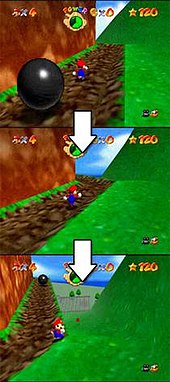
Instead of staying behind Mario, the camera rotates to show the path.
Super Mario 64 was key to the early success of and anticipation for the Nintendo 64.[60] [78] [98] [99] Lee Hutchinson, a former Babbage's employee, notes how the game was spurred by a feverish video game press,[100] and how the success of the game defied the rule that a wide variety of launch games were necessary for broad appeal.[101] However, the Nintendo 64 eventually lost much of its market share to Sony's PlayStation, partly due to its cartridge and controller design decisions, which were reportedly implemented by Miyamoto for Super Mario 64.[102]
In 2012, Super Mario 64 was among the 80 entries in the Smithsonian American Art Museum's Art of Video Games exhibit.[103]
Though not the first 3D platformer or 3D Nintendo game, PC Magazine 's K. Thor Jensen considers Super Mario 64 to be the first truly realized 3D platformer, by these criteria: innovations in player-character personality; intuitive, perfectible gameplay; and integration of camera control into core gameplay, which he called the medium's true evolutionary leap.[104]
Influence
Super Mario 64 set many precedents for 3D platformers[78] [102] [105] as one of the most influential video games. GameDaily wrote that it "defined the 3-D platform experience".[106] It is acknowledged by 1UP.com for pioneering the transition of a 2D series into full 3D.[102] GamesTM said many game companies, including Nintendo, have tried to develop a platform game to match Super Mario 64. [107]
Super Mario 64 is known for its nonlinear, open freedom, which has been acclaimed by video game developers. Its central hub world provides a safe tutorial and a level selector, and is a staple of the 3D platform genre. In the 3D transition, many of the series's conventions were rethought drastically, placing emphasis on exploration over traditional platform jumping, or "hop and bop" action. Though some disputed its quality, others argued that it established an entirely new genre for the series.[108] Its mission-based level design inspired game designers such as Martin Hollis, producer and director of Rare's GoldenEye 007.[109] Dan Houser, a prominent figure in the development of the Grand Theft Auto series, stated, "Anyone who makes 3D games who says they've not borrowed something from Mario or Zelda [of the Nintendo 64] is lying."[110] Tetsuya Nomura, a leading designer at Square Enix, stated in 2016 that Super Mario 64 prompted the creation of the Kingdom Hearts series.[111] Chris Sutherland, who served as the lead designer for Banjo-Kazooie, agreed that Super Mario 64 set the benchmark for 3D platformers and claimed that any other game in the genre on the Nintendo 64 would inevitably be compared with Super Mario 64.[39]
Super Mario 64 introduced a free-floating camera that can be controlled independently of the character.[105] To increase freedom of exploration and fluid control in a 3D world, Super Mario 64 designers created a dynamic virtual video camera that turns and accelerates according to the character's actions,[112] operated by the in-game character Lakitu.[8] This camera system became the standard for 3D platform games.[9] Nintendo Power stated the camera control scheme is what transitioned platform games into 3D,[113] and that the game, along with The Legend of Zelda: Ocarina of Time, "blazed trails" into the 3D era.[114]
Edge said Super Mario 64 changed "gamers' expectations of 3D movement forever".[98] The Nintendo 64's analog stick affords more precise and wide-ranging character movements than the digital D-pads of other consoles, and Super Mario 64 's use of this was novel. At the time, 3D games generally allow the player to either control the character in relation to a fixed camera angle or in relation to the character's perspective. Super Mario 64 's innovative controls are fully analog and interpret a 360-degree range of motion into navigation through a 3D space relative to the camera. The analog stick allows for precise control over subtleties such as running speed.[115] Electronic Gaming Monthly in 2005 ranked Super Mario 64 the most important game since they began publication in 1989, stating that, while there were 3D games before it, "Nintendo's was the first to get the control scheme right."[116]
In July 2021, a pristine, sealed copy of Super Mario 64 was auctioned for $1,560,000, the largest amount ever paid for a video game.[117] [118] Heritage Auctions's video games specialist said, "It seems impossible to overstate the importance of this title, not only to the history of Mario and Nintendo but to video games as a whole."[119]
Rumors, conspiracy theories and glitches
Rumors spread rapidly after the game's release. The most popular was a pervasive rumor that Luigi was an unlockable character. In 1996, IGN offered a prize of $100 if a player could find Luigi,[120] but after one week, he wasn't found.[121] Fueling the rumor was a very blurry message on a statue in the courtyard of Princess Peach's Castle, thought to say "L is real 2401".[122] This was disproved in 1998, when a fan received a letter from Nintendo that the programmers included the text as a joke and it wasn't supposed to say anything.[122] In July 2020, the unused assets for Luigi from the scrapped multiplayer mode were discovered in the game's files in an event known as the Nintendo Gigaleak.[123]
Conspiracy theories about the game became popular in 2020, and were grouped into the "Super Mario 64 iceberg", with the less likely theories representing places closer to the bottom of the "ocean".[124] One popular rumor was the "Wario Apparition", based off of an E3 1996 presentation with Charles Martinet voicing a disembodied Wario head. Some fans believed that the Wario head remained in some copies of the game, which was part of another theory that "every copy of Super Mario 64 is personalized".[124] [125] [126]
Players used glitches to reach previously unreachable parts of the game, including a coin that had not been collected until eighteen years after release.[127] Speedrun techniques include the Lakitu skip, Bomb-omb clip, and the infamous backwards long jump glitch,[128] however, the latter was patched in the Super Mario 3D All-Stars re-release.[129] In 2013, YouTuber Vinesauce posted a collection of clips of corruptions of the game, replicated with a program named 'naughty'.[130] [131] Pannenkoek2012's highly technical analysis of Super Mario 64 glitches and mechanics has been covered many times in the video game press.[132] [133] [134]
Fan projects
The following is a list of fan remakes, ROM hacks and projects created by fans of Super Mario 64.
- Super Mario 64: Chaos Edition , a PC-emulated version of the original that loads codes which cause bizarre behavior. The game received coverage after Vinesauce posted a playthrough of the game.[135] [136]
- Super Mario Run 64 , converting the game into a 2.5D running game in the spirit of Super Mario Run.[137]
- Super Mario 64 Online , enabling online multiplayer.[138] [139] [140] It was taken down after a copyright strike by Nintendo. It was later reuploaded and renamed to Net64 .[141]
- Super Mario 64 Maker , a Mario Maker-like level editor.[142]
- Super Mario 64 Odyssey , featuring levels based on Super Mario Odyssey while also adding its mechanic of possessing enemies by throwing Mario's hat.[143]
- Super Mario 64: Last Impact , an original game that incorporates elements from other Mario games, such as the Fire Flower from Super Mario Bros., the F.L.U.D.D. cannon from Super Mario Sunshine, and the Bee Mushroom from Super Mario Galaxy.[144] [145] [146]
- Super Mario 64: Ocarina of Time , in which The Legend of Zelda: Ocarina of Time world is recreated in Super Mario 64 's engine, with new gameplay elements, puzzles, and a story.[147] [148] [149]
- Open World Mario 64 , a battle royale-style mod set on a huge map made up of all Super Mario 64 levels, in the style of Fortnite Battle Royale and PlayerUnknown's Battlegrounds.[150]
- First Person Mario 64 , that changes the camera mode to first-person, often making the game much more challenging due to how the game demands acrobatic movements,[151] and how the game doesn't render objects when they're too close to the camera.[152] [153]
- Super Mario 64 Plus , featuring a new permadeath option, bug fixes, an improved camera system and 60 FPS emulation.[154]
- Super Mario 64 HD , a high-definition remake of the first level of Super Mario 64, Bob-Omb Battlefield, using the Unity game engine. The project was taken down following a copyright claim by Nintendo.[155]
- In 2019, fans decompiled the original ROM image into C source code, allowing Super Mario 64 to be natively ported to any system.
- In 2020, fans released a Windows port with support for widescreen displays and 4K resolution.[156] Nintendo enlisted a law firm to remove videos of the port and its listings from websites.[157] Fans created ports for several more platforms, including Nintendo 3DS,[158] PlayStation 2, PlayStation Vita, Dreamcast, and Android.[159]
Successors
A sequel was planned for the 64DD.[160] In July 1996, Nintendo insiders stated that Miyamoto was assembling a team consisting mostly of developers who had worked on Super Mario 64.[161] Miyamoto mentioned at the 1997 E3 convention that he was "just getting started" on the project.[162] The project was canceled due to its lack of progress and the commercial failure of the 64DD.[160] [163]
Super Mario 64 successors include Super Mario Sunshine (2002) for the GameCube and Super Mario Galaxy (2007) for the Wii, building on its core design of power-ups and its 3D, open-ended gameplay.[164] [165] Super Mario Galaxy 2 (2010) includes a remake of Super Mario 64 's Whomp's Fortress level called Throwback Galaxy.[166] Super Mario 3D Land (2011) and Super Mario 3D World (2013) are departures from the open-ended design, instead focused on platforming reminiscent of 2D games.[167] The Nintendo Switch game Super Mario Odyssey (2017) returned to Super Mario 64 's open design.[168]
Plasticity studies
In 2013, a study was conducted to see the plasticity effects on the human brain after playing Super Mario 64—chosen for its navigation element and the ability to play in a three-dimensional environment—for at least 30 minutes every day for 2 months. The study concluded that doing the previously mentioned activity caused the grey matter (a major part of the central nervous system) to increase in the right hippocampal formation and the right dorsolateral prefrontal cortex—brain areas thought to contribute to spatial navigation, working memory, and motor planning.[169] A similar study was conducted in 2017, where adults were randomized into three groups, a control group, a group that took online piano lessons, and a group that played a 3D platform game (i.e. Super Mario 64), for 6 months, at least 30 minutes per day, and at least 5 days a week. At the end of the study, the control group had suffered from a decrease in grey matter, the music group had an increase, mostly in the dorsolateral prefrontal cortex and cerebellum, and the Super Mario 64 group also had an increase, mostly in the hippocampus and cerebellum.[170]
See also
- Super Mario 128
Notes
- ^ Japanese: スーパーマリオ64, Hepburn: Sūpā Mario 64
- ^ Japanese: スーパーマリオ64 振動パック対応バージョン, Hepburn: Sūpā Mario 64 Shindō Pak Taiō Bājon
- ^ Nintendo Power scored Super Mario 64 4.5/5 twice for graphics/sound and theme/fun, 3.8/5 for play control, and 5/5 for challenge.[69]
References
- ^ a b Kohler, Chris (September 29, 2016). "Nintendo 64 Came Out 20 Years Ago. Here's How a Teenaged Me Reviewed It". Wired. Condé Nast Publications. Archived from the original on September 29, 2016. Retrieved November 17, 2021.
- ^ a b Buchanan, Levi (September 29, 2008). "Nintendo 64 Week: Day One". IGN. Ziff Davis, LLC. Archived from the original on February 23, 2013. Retrieved September 17, 2021.
- ^ a b Yin-Poole, Wesley (March 1, 2017). "The Nintendo 64 Turns 20 in Europe". Eurogamer. Gamer Network. Archived from the original on March 3, 2017. Retrieved November 17, 2021.
- ^ a b Kisco, Okumura (October 15, 2018). "クッパのイメージはスッポン。任天堂のキャラクタービジュアルの礎を作った、小田部羊一氏がみずからの仕事をふり返る(2/3)" [Bowser's Image Is That of a Soft-shelled Turtle. Yoichi Kotabe, Who Laid the Foundation for Nintendo's Character Visuals, Looks Back on His Own Work]. Famitsu (in Japanese). Gzbrain, Inc. p. 2. Archived from the original on October 19, 2018. Retrieved November 5, 2021.
- ^ "Nintendo 64 Shakes Up Shoshinkai". GamePro. No. 90. International Data Group. March 1996. p. 22.
- ^ MacDonald, Keza (September 14, 2020). "Super Mario at 35: Mario's Makers on Nintendo's Most Enduring Mascot". The Guardian. Archived from the original on September 14, 2020. Retrieved October 21, 2021.
'When we moved to 3D for the first time in Super Mario 64 we became acutely aware of how difficult it is to jump on enemies moving in a 3D space,' [Miyamoto] explains. 'So we created lots of new moves other than jumping that make use of the features of 3D...'
- ^ a b c d e f g Official Super Mario 64 Player's Guide. Nintendo. 1996.
- ^ a b c Super Mario 64 Instruction Booklet. Nintendo. 1996. NUS-NSME-USA.
- ^ a b c d "Full Coverage - Super Mario 64". Nintendo Power. No. 88. Nintendo. September 1996. pp. 14–23.
- ^ a b c d e f g Perry, Doug (September 25, 1996). "Super Mario 64 Review". IGN. Ziff Davis, LLC. Archived from the original on August 6, 2017. Retrieved February 14, 2018.
- ^ Nintendo EAD. Super Mario 64. Nintendo.
You've found 70 Power Stars! The mystery of the endless stairs is solved, thanks to you—and is Bowser ever upset! Now, on to the final bout!
- ^ Nintendo EAD. Super Mario 64. Nintendo. Level/area: roof of Princess Peach's Castle.
Yoshi: Thanks for playing Super Mario 64! This is the end of the game, but not the end of the fun.
We want you to keep on playing, so we have a little something for you. We hope you like it!
Enjoy!!!
—The Super Mario 64 Team
- ^ Spear, Rebecca (September 18, 2020). "Super Mario 3D All-Stars: Tips, Tricks, and Secrets for Super Mario 64". iMore. Future US, Inc. Archived from the original on September 19, 2020. Retrieved November 22, 2021.
- ^ "NG Alphas: Super Mario 64". Next Generation. No. 20. Imagine Media. August 1996. p. 53.
- ^ Hernandez, Patricia (November 17, 2014). "Outrunning a 1-up Mushroom in Super Mario 64 Is a Great Tradition". Kotaku. G/O Media. Archived from the original on November 19, 2014. Retrieved April 7, 2021.
- ^ Nintendo EAD (September 29, 1996). Super Mario 64 (Nintendo 64). Nintendo.
Princess Peach's note: "Dear Mario: Please come to the castle. I've baked a cake for you. Yours truly—Princess Toadstool, Peach."
- ^ Nintendo EAD (September 29, 1996). Super Mario 64 (Nintendo 64). Nintendo.
Princess Peach: "Mario! The power of the Stars is restored to the castle... and it's all thanks to you! Thank you, Mario. We have to do something special for you... Listen, everybody, let's bake a delicious cake... for Mario..."
- ^ a b c d e Miyamoto, Shigeru; Tezuka, Takashi (January 1996). "The Game Guys - (Shoshinkai 1995)". Nintendo Power (Interview) (80). Nintendo. Archived from the original on February 24, 2011. Retrieved May 25, 2014.
- ^ a b "IGN Top 100 Games 2007: 5 Super Mario 64". IGN. Ziff Davis, LLC. 2007. Archived from the original on February 16, 2012. Retrieved February 13, 2018.
- ^ "Dylan Cuthbert". Twitter. Archived from the original on May 25, 2014. Retrieved May 25, 2014.
SNES Central @dylancuthbert I'm researching unreleased SNES games, was a game called "Super Mario FX" ever in development? Dylan Cuthbert @snescentral no, that was the internal code name for the FX chip"
- ^ Z. Wright, Andy Crane (January 14, 1993). "Report: The CES in Las Vegas". Bad Influence!. Series 1. Episode 10. Event occurs at 6:54. ITV. CITV. Retrieved October 14, 2021. Archived from the original on 15 October 2021.
- ^ Walker, Ian (August 3, 2020). "Super Mario 64 Took 622 Days To Develop, Suggests 'Gigaleak' Document". Kotaku. G/O Media. Archived from the original on November 15, 2020. Retrieved August 5, 2020.
- ^ "Shigeru Miyamoto: Mario 2 Might Be Ready Next Year". Electronic Gaming Monthly. No. 98. Ziff Davis, LLC. September 1997. p. 78.
- ^ a b c d "The Making of Mario 64: Giles Goddard Interview". NGC Magazine. No. 61. Future Publishing. December 2001. Archived from the original on November 15, 2020. Retrieved September 9, 2014.
- ^ Miyamoto, Shigeru (1996). "Shigeru Miyamoto - Producer/Director". Super Mario 64 Strategy Guide (Interview) (in Japanese).
- ^ Miyamoto, Shigeru (March 18, 1999). "GDC: Miyamoto Keynote Speech". IGN. Ziff Davis, LLC. Archived from the original on October 24, 2017. Retrieved October 23, 2017.
- ^ Sterling, Jim (November 25, 2009). "Mario 64 Once Had a Co-op Mode". Destructoid. Enthusiast Gaming. Archived from the original on March 7, 2012. Retrieved August 30, 2011.
- ^ Alexander, Leigh; Boyer, Brandon (November 27, 2007). "MIGS 2007: Nintendo's Koizumi on the Path From Garden to Galaxy". Gamasutra. Informa. Archived from the original on November 12, 2017. Retrieved February 14, 2018.
- ^ "Inside Zelda". Zelda Universe. Nintendo. p. 4. Archived from the original on March 10, 2016. Retrieved April 30, 2021.
- ^ Super Mario 64 Instruction Booklet. Nintendo. 1996. p. 24.
- ^ "Shigeru Miyamoto: The Master of the Game". Next Generation. No. 14. Imagine Media. February 1996. pp. 45–47.
Personally, I wanted to make a game that looks like a 3D interactive cartoon. I wanted to create a small garden where Mario can meet real-time 3D characters and the player would be able to move the character with the controller just as if it were a real cartoon.
- ^ "Nintendo's Lincoln Speaks Out on the Ultra 64!". Electronic Gaming Monthly. No. 78. Ziff Davis, LLC. January 1996. pp. 74–75.
- ^ "Nintendo's Yamauchi Speaks Out". Next Generation. No. 20. Imagine Media. August 1996. p. 30.
- ^ "Super Mario 64 - Original Game Soundtrack". AllMusic. Complex Media. Archived from the original on February 15, 2018. Retrieved February 14, 2018.
- ^ a b c "効果音は空気のような存在" [Sound Effects Are Like Air]. nintendo.co.jp. Nintendo. Archived from the original on November 15, 2020. Retrieved June 29, 2020.
- ^ "Miyamoto Speaks". Nintendo Power. No. 89. Nintendo. October 1996. p. 67.
- ^ a b The Whizz (February 1996). "The Ultra 64: Power Packed". GamePro. No. 89. International Data Group. pp. 20–21 – via archive.org.
- ^ a b Semrad, Ed (February 1996). "Ultra 64 Unveiled" (PDF). Electronic Gaming Monthly. No. 79. Sendai Publishing. p. 6. Archived from the original (PDF) on August 9, 2018.
- ^ a b Thorpe, Nick; Albiges, Luke; et al. (June 23, 2021). "Super Mario 64 Turns 25: Examining the Impact of the N64's Most Revolutionary Game". GamesRadar+. Future Publishing. Archived from the original on June 23, 2021. Retrieved November 19, 2021.
- ^ Whitehead, Thomas (June 26, 2014). "The Unreleased Super Mario 64 DD Edition Appears to Have Been Uncovered". Nintendo Life. NLife Media. Archived from the original on June 28, 2014. Retrieved November 18, 2021.
- ^ "Shindou Super Mario 64 (Rumble Pak Vers.)". IGN. Ziff Davis, LLC. Archived from the original on February 23, 2011. Retrieved October 22, 2006.
- ^ Davies, Jonti. "Shindou Super Mario 64". AllGame. All Media Network. Archived from the original on November 15, 2014. Retrieved October 22, 2006.
- ^ Thomas, Lucas M. (January 10, 2007). "Super Mario 64 VC Review". IGN. Ziff Davis, LLC. Archived from the original on October 9, 2008. Retrieved September 17, 2008.
- ^ a b Gerstmann, Jeff (July 12, 2011). "Super Mario 64 Virtual Console Review". GameSpot. CBS Interactive. Archived from the original on August 24, 2017. Retrieved February 14, 2018.
- ^ Farokhmanesh, Megan (September 3, 2020). "Super Mario 3D World and Other Classic Mario Games Are Coming to the Switch". The Verge. Vox Media. Archived from the original on September 6, 2020. Retrieved September 3, 2020.
- ^ Good, Owen S. (October 27, 2021). "Should I Buy Nintendo Switch Online + Expansion Pack?". Polygon. Vox Media. Archived from the original on October 27, 2021. Retrieved November 23, 2021.
- ^ Gerstmann, Jeff (November 19, 2004). "Super Mario 64 DS Review". GameSpot. CNET Networks, Inc. Archived from the original on November 5, 2011. Retrieved October 22, 2006.
- ^ "Super Mario 64 DS for Nintendo DS Reviews". Metacritic. CBS Interactive. Archived from the original on January 22, 2009. Retrieved April 18, 2008.
- ^ "Super Mario 64 DS Reviews". GameRankings. CBS Interactive. Archived from the original on April 6, 2008. Retrieved April 18, 2008.
- ^ "Financial Results Briefing for the Fiscal Year Ended March 2008: Supplementary Information" (PDF). Nintendo. April 25, 2008. p. 6. Archived (PDF) from the original on September 10, 2008. Retrieved August 3, 2008.
- ^ a b "Super Mario 64 for Nintendo 64". GameRankings. CBS Interactive. Archived from the original on February 15, 2017. Retrieved February 14, 2018.
- ^ a b "Super Mario 64 for Nintendo 64 Reviews". Metacritic. CBS Interactive. Archived from the original on March 12, 2018. Retrieved February 14, 2018.
- ^ a b Daviest, Jonti. "Super Mario 64 - Review". AllGame. All Media Network. Archived from the original on November 14, 2014. Retrieved January 25, 2021.
- ^ a b c d Davies, Paul (September 1996). "Super Mario 64". Computer and Video Games. No. 178. p. 78. Retrieved June 2, 2021.
- ^ a b "Super Mario 64". Edge. No. 35. Future Publishing. August 1996. pp. 68–71.
- ^ a b c "Super Mario 64". Electronic Gaming Monthly. No. 174. Ziff Davis, LLC. January 2004. p. 189 – via archive.org.
- ^ a b c Lucas, Victor. "Super Mario 64". EP Daily. EP Media, Ltd. Archived from the original on May 1, 2004. Retrieved June 2, 2021.
- ^ Orland, Kyle (October 24, 2007). "Famitsu Gives Super Mario Galaxy 38/40". Engadget. Oath Inc. Archived from the original on December 12, 2017. Retrieved February 14, 2018.
- ^ "Super Mario 64 Review". Game Informer. No. 40. Gamestop. August 1996.
- ^ a b c Preston, Cathy (July 2007). "Retro Review - Super Mario 64". Game Informer. No. 171. Gamestop. p. 114.
- ^ Takuhi; Evil Lights; Orion; E. Storm (September 1996). "Viewpoint". GameFan. Vol. 4 no. 9. p. 22. Retrieved June 2, 2021.
- ^ a b "ProReview: Super Mario 64". GamePro. No. 97. International Data Group. October 1996. pp. 74–75.
- ^ "Super Mario 64 – N64". GameRevolution. AtomicOnline. Archived from the original on October 27, 2006. Retrieved June 2, 2021.
- ^ a b "Super Mario 64 Review". GameSpot. CBS Interactive. December 1, 1996. Archived from the original on February 15, 2018. Retrieved February 14, 2018.
- ^ a b Alegeropoulos, Nino (March 1997). "Super Mario 64". Hyper. No. 41. pp. 44–47. Retrieved June 2, 2021.
- ^ a b c "Super Mario 64". N64 Magazine. No. 1. April 1997. pp. 44–45. Retrieved June 2, 2021.
- ^ a b c "King of the Hill". Next Generation Magazine. Vol. 2 no. 21. Imagine Media. September 1996. p. 147 – via archive.org.
- ^ a b c d Dillard, Corbie (November 20, 2006). "Super Mario 64 (N64) Review". Nintendo Life. NLife Media. Archived from the original on April 6, 2015. Retrieved November 25, 2021.
- ^ a b "Now Playing - September 1996". Nintendo Power. No. 88. Nintendo. September 1996. p. 96.
- ^ a b "Super Mario 64 – Nintendo 64". Official Nintendo Magazine. Archived from the original on July 11, 2007. Retrieved June 2, 2021.
- ^ Por Majorie Bros (August 1996). "Super Mario 64". Super GamePower. No. 29. p. 20. Retrieved June 2, 2021.
- ^ "Super Mario 64". Total!. No. 57. September 1996. pp. 44–63. Retrieved June 2, 2021.
- ^ "Super Mario 64". Video Games (in German). February 1997. pp. 64–68. Retrieved June 2, 2021.
- ^ a b "Digitiser's Top Games of 1997". Digitiser. January 13, 1998. Archived from the original on October 19, 2021. Retrieved October 19, 2021.
- ^ a b "Maximum Reviews: Super Mario 64". Maximum. No. 7. Emap International Limited. June 1996. pp. 116–7.
- ^ Goodfellow, Kris (June 3, 1996). "Mario Is Looking Better With Age". archive.nytimes.com. The New York Times Company. Archived from the original on October 21, 2021.
- ^ a b c Radakovic, Nebojsa (June 6, 2004). "Super Mario 64 Review". GameRevolution. Evolve Media. Archived from the original on February 15, 2018. Retrieved February 14, 2018.
- ^ a b c d "100 Best Games of All Time". Electronic Gaming Monthly. No. 100. Ziff Davis, LLC. November 1997. pp. 155–6. Note: Contrary to the title, the intro to the article (on page 100) explicitly states that the list covers console video games only, meaning PC games and arcade games were not eligible.
- ^ "Inventor Pales Beside His 'Mario' Creation". El Paso Times. Associated Press. March 16, 1997. p. 56. Archived from the original on October 19, 2021.
- ^ "U.S. Top 20 Best-selling Games in 1995–1999 Ranked on Dollar Sales". Twitter. The NPD Group. January 17, 2020. Archived from the original on January 17, 2020. Retrieved October 11, 2021.
- ^ Horwitz, Jer (May 15, 1997). "Saturn's Distant Orbit". GameSpot. ZDNet. Archived from the original on March 12, 2000.
- ^ Frauenfelder, Mark (May 2001). "Death Match". Wired. Archived from the original on January 29, 2016. Retrieved October 30, 2021.
- ^ Lazich, Robert (July 28, 2003). Market Share Reporter 2004. Cengage Gale. p. 283. ISBN978-0-7876-7219-5.
Best-Selling Video Games, 1995-2002
Data show units sold, in millions, from 1995 through September 2002.
Super Mario 64 ............ 5.9 - ^ "Milia News; ECCSELL Awards Name Winners". GameSpot. ZDNet. February 12, 1999. Archived from the original on August 30, 1999. Retrieved January 5, 2019.
- ^ Craig Glenday, ed. (March 11, 2008). "Hardware: Best-Sellers by Platform". Guinness World Records Gamer's Edition 2008. Guinness World Records. Guinness. p. 50. ISBN978-1-904994-21-3.
- ^ O'Malley, James (September 11, 2015). "30 Best-selling Super Mario Games of All Time on the Plumber's 30th Birthday". Gizmodo. G/O Media. Archived from the original on September 14, 2015. Retrieved April 24, 2017.
- ^ Thorsen, Tor (June 5, 2007). "Wii VC: 4.7m Downloads, 100 Games". GameSpot. CBS Interactive. Archived from the original on February 14, 2018. Retrieved February 14, 2018.
- ^ "IGN's Top 100 Games of All Time: 10-1". IGN. Ziff Davis, LLC. 2003. Archived from the original on March 6, 2015. Retrieved February 13, 2018.
- ^ "IGN's Top 100 Games: 10-1". IGN. Ziff Davis, LLC. 2005. Archived from the original on February 28, 2015. Retrieved February 13, 2018.
- ^ "The Top 200 Games of All Time". Game Informer. No. 200. Gamestop. December 2009. pp. 44–79. ISSN 1067-6392. OCLC 27315596.
- ^ "Top 100 Games of All Time". Game Informer. Gamestop. August 2001. p. 36.
- ^ "The 100 Best Games To Play Today: 5-1". Edge. Future Publishing. March 9, 2009. Archived from the original on October 29, 2014. Retrieved February 14, 2018.
- ^ East, Tom (March 2, 2009). "100 Best Nintendo Games - Part 6". Official Nintendo Magazine. Future Publishing. Archived from the original on July 14, 2014. Retrieved February 14, 2018.
- ^ "NP Top 200". Nintendo Power. No. 200. Nintendo. February 2006. pp. 58–66.
- ^ "The Best of '96". Electronic Gaming Monthly. No. 92. Ziff Davis, LLC. March 1997. pp. 82–91.
- ^ "Spotlight Award Winners". Next Generation. No. 31. Imagine Media. July 1997. p. 21.
- ^ "The Essential Buyers' Guide Reviews". Maximum. No. 7. Emap International Limited. June 1996. p. 115.
- ^ a b "Who Dares Wins". Edge. No. 177. Future Publishing. July 2007. pp. 62–71.
- ^ "Top 25 Greatest Nintendo Games – No. 7 Super Mario 64 (N64)". GameDaily. AOL. Archived from the original on March 12, 2008. Retrieved February 9, 2008.
- ^ Hutchinson, Lee (January 13, 2013). "How I Launched 3 Consoles (And Found True Love) At Babbage's Store No. 9". Ars Technica. Condé Nast. Archived from the original on November 15, 2020. Retrieved June 20, 2020.
...if the gaming press was to be believed, Super Mario 64 was going to be the greatest game ever released anywhere, and it might also cure cancer and feed the world's starving children.
- ^ Hutchinson, Lee (January 13, 2013). "How I Launched 3 Consoles (And Found True Love) At Babbage's Store No. 9". Ars Technica. Condé Nast. Archived from the original on November 15, 2020. Retrieved June 20, 2020.
The rule that a console must have a broad spectrum of launch titles to appeal to the North American audience was generally true, but Nintendo found the exception: a single amazing title, with well-implemented 3D gameplay that most console players had never experienced, could bear the weight of the entire system on its shoulders.
- ^ a b c "The Essential 50 Part 36: Super Mario 64". 1UP.com. Archived from the original on March 28, 2016. Retrieved February 13, 2018.
- ^ Epstein, Mike (May 5, 2011). "The Smithsonian Has Picked the Games of Its Art of Video Games Exhibit". Kotaku. G/O Media. Archived from the original on November 6, 2010.
- ^ Jensen, K. Thor (June 23, 2021). "25 Years Ago, Super Mario 64 Rocketed Nintendo Into the Third Dimension". PC Magazine. Ziff Davis, LLC. Archived from the original on June 23, 2021. Retrieved June 30, 2021.
- ^ a b Craig Glenday, ed. (March 11, 2008). "Record Breaking Games: Platform Games". Guinness World Records Gamer's Edition 2008. Guinness World Records. Guinness. pp. 108–110. ISBN978-1-904994-21-3.
- ^ "Most Influential Video Games". GameDaily. AOL. Archived from the original on June 18, 2009. Retrieved January 23, 2008.
- ^ "Super Mario Galaxy Review". gamesTM. No. 63. Imagine Publishing. November 2007. p. 129.
- ^ Etherington, Daniel (October 25, 2003). "Platform Video Games Evolve". BBC News. BBC. Archived from the original on June 17, 2004. Retrieved February 14, 2018.
- ^ "The Making of GoldenEye 007". zoonami.com. Zoonami. September 2, 2004. Archived from the original on July 18, 2011. Retrieved February 11, 2006.
- ^ Houser, Dan (November 9, 2012). "Americana at Its Most Felonious: Q. And A.: Rockstar's Dan Houser on Grand Theft Auto V". New York Times (Interview). Interviewed by Chris Suellentrop. The New York Times Company. Archived from the original on September 26, 2013. Retrieved March 3, 2015.
- ^ "Sakurai x Nomura". Famitsu. No. 1415. Enterbrain. January 2016.
- ^ Rabin, Steve (July 26, 2001). "Classic Super Mario 64 Third-Person Control and Animation". Game Programming Gems 2. 2: 424 – via archive.org.
- ^ "Everything Old-School is New Again". Nintendo Power. No. Winter Special 2008. Nintendo. Winter 2008. p. 42.
- ^ Nintendo Power. Nintendo. 2010. p. 48.
- ^ "N64 Exclusive". Nintendo Power. No. 85. Nintendo. June 1996. pp. 16–17.
- ^ "The 10 Most Important Games". Electronic Gaming Monthly. No. 187. Ziff Davis, LLC. January 2005. p. 48.
- ^ Molloy, David (July 12, 2021). "Super Mario 64 Game Sells for Record-breaking $1.5m at Auction". BBC News. BBC. Archived from the original on July 12, 2021. Retrieved July 12, 2021.
- ^ Kreps, Daniel (July 11, 2021). "Pristine 'Super Mario 64' Breaks Video Game Auction Record With $1.56 Million". Rolling Stone. Penske Media Corporation. Archived from the original on July 11, 2021. Retrieved July 12, 2021.
- ^ Hall, Rachel (July 12, 2021). "Mint Condition Super Mario 64 Game Sold for Record $1.5m". The Guardian. Archived from the original on July 12, 2021. Retrieved July 12, 2021.
- ^ "In Search of Luigi". IGN. Ziff Davis, LLC. November 13, 1996. Archived from the original on November 11, 2007. Retrieved August 4, 2021.
- ^ "Luigi Still Missing". IGN. Ziff Davis, LLC. November 20, 1996. Archived from the original on October 8, 2007. Retrieved October 11, 2007.
- ^ a b Lane, Gavin (August 28, 2019). "Feature: Has a Decades-old Super Mario 64 Mystery Finally Been Cleared Up?". Nintendo Life. NLife Media. Archived from the original on August 29, 2019. Retrieved November 17, 2021.
- ^ Hernandez, Patricia (July 27, 2020). "Fans Celebrate as Nintendo Gigaleak Validates Super Mario 64 Luigi Myth". Polygon. Vox Media. Archived from the original on July 27, 2020. Retrieved November 12, 2021.
- ^ a b Hernandez, Patricia (September 15, 2020). "In 2020, Super Mario 64 Has Been Reborn as a Horror Game". Polygon. Vox Media. Archived from the original on September 15, 2020. Retrieved November 12, 2021.
- ^ Williams, Leah J. (September 17, 2020). "What Is the Super Mario 64 Conspiracy Theory Iceberg?". Kotaku Australia. Pedestrian Group. Archived from the original on September 29, 2020. Retrieved November 7, 2021.
- ^ Spear, Rebecca (September 20, 2020). "Myths, Lore and Conspiracy Theories Surrounding Super Mario 64". iMore. Future US, Inc. Archived from the original on September 20, 2020. Retrieved November 7, 2021.
- ^ Hernandez, Patricia (July 8, 2014). "The Super Mario 64 Coin That Took 18 Years To Collect". Kotaku. G/O Media. Archived from the original on November 15, 2020. Retrieved October 25, 2016.
- ^ Medina, Mark (October 18, 2017). "9 Insane Tricks Used by Mario 64 Speedrunners - IGN". IGN. Ziff Davis, LLC. Archived from the original on October 21, 2017. Retrieved July 20, 2021.
- ^ Medina, Mark (September 16, 2020). "Super Mario 3D All-Stars: Mario 64 Speedruns Won't Be Nearly as Fast". IGN. Ziff Davis, LLC. Archived from the original on September 19, 2020. Retrieved November 3, 2021.
- ^ Latshaw, Tim (December 3, 2013). "Weirdness: Super Mario 64 Corruptions Yield Hilarious And/or Terrifying Results". Nintendo Life. NLife Media. Archived from the original on December 4, 2013. Retrieved October 31, 2021.
- ^ Hernandez, Patricia (December 2, 2013). "Super Mario 64 as a Glitchy Nightmare". Kotaku. G/O Media. Archived from the original on December 3, 2013. Retrieved November 15, 2021.
- ^ Alexandra, Heather (April 11, 2017). "Famous Super Mario 64 Trick Involving Parallel Universes Finally Becomes Real". Kotaku. G/O Media. Archived from the original on April 11, 2017. Retrieved July 1, 2021.
- ^ Hernandez, Patricia (August 15, 2017). "YouTube's Mario 64 Genius Sounds Overwhelmed With His Popularity". Kotaku. G/O Media. Archived from the original on August 15, 2017. Retrieved November 15, 2021.
- ^ Hernandez, Patricia (March 4, 2019). "Super Mario 64 Player Beats Bowser Level Without Using Joystick". Polygon. Vox Media. Archived from the original on March 5, 2019. Retrieved November 15, 2021.
- ^ Grayson, Nathan (November 7, 2014). "A Terrifying New Way To Play Mario 64". Kotaku. G/O Media. Archived from the original on November 7, 2014. Retrieved November 17, 2021.
- ^ Grayson, Nathan (March 19, 2015). "Someone Actually Beat The Ridiculous Mario 64 'Chaos Edition'". Kotaku. G/O Media. Archived from the original on March 20, 2015. Retrieved November 17, 2021.
- ^ Whitehead, Thomas (September 9, 2016). "Video: A Modder Has Made Super Mario Run 64". Nintendo Life. NLife Media. Archived from the original on September 11, 2016. Retrieved December 17, 2018.
- ^ Frank, Allegra (September 11, 2017). "Super Mario 64 Online Lets You Play the Classic With Your Pals". Polygon. Vox Media. Archived from the original on September 11, 2017. Retrieved December 17, 2018.
- ^ Lumb, David (September 11, 2017). "'Super Mario 64' Is an Online Multiplayer Game Thanks to Hero Modders". Engadget. Oath Inc. Archived from the original on September 11, 2017. Retrieved December 17, 2018.
- ^ Plunkett, Luke (September 10, 2017). "24 People Can Now Play Super Mario 64 Online Together". Kotaku. G/O Media. Archived from the original on September 12, 2017. Retrieved September 11, 2017.
- ^ Good, Owen S. (September 20, 2017). "Super Mario 64 Online Taken Down by Nintendo Copyright Strikes (Update)". Polygon. Vox Media. Archived from the original on September 21, 2017. Retrieved December 17, 2018.
- ^ Plunkett, Luke (July 18, 2017). "Fan Creates Super Mario 64 Maker". Kotaku. G/O Media. Archived from the original on September 12, 2017. Retrieved September 11, 2017.
- ^ Plunkett, Luke (June 14, 2017). "Mod Brings Super Mario Odyssey's Hat Powers to Super Mario 64". Kotaku. G/O Media. Archived from the original on September 12, 2017. Retrieved September 11, 2017.
- ^ Sayer, Matt (October 24, 2016). "Super Mario 64 ROM Hack Last Impact Is the Sequel We Never Got". PC Gamer. Future Publishing. Archived from the original on October 28, 2016. Retrieved December 17, 2018.
- ^ Hernandez, Patricia (October 3, 2016). "A Giant Super Mario 64 Hack That Reinvents the Game". Kotaku. G/O Media. Archived from the original on September 12, 2017. Retrieved September 11, 2017.
- ^ Whitehead, Thomas (October 3, 2016). "SM64: Last Impact Is a Hugely Ambitious Super Mario 64 Fan Mod". Nintendo Life. NLife Media. Archived from the original on October 4, 2016. Retrieved December 17, 2018.
- ^ "Zelda: Ocarina of Time Completely Remade in Super Mario 64". IGN. Ziff Davis, LLC. March 29, 2018. Archived from the original on March 31, 2018. Retrieved December 17, 2018.
- ^ Frank, Allegra (January 25, 2018). "Super Zelda 64 Is a Dream Mod for Nintendo 64 Fans (Update)". Polygon. Vox Media. Archived from the original on January 25, 2018. Retrieved December 17, 2018.
- ^ Marnell, Blair (January 27, 2018). "Magical Mod Combines Zelda: Ocarina of Time With Super Mario 64". Nerdist. Archived from the original on January 28, 2018. Retrieved December 17, 2018.
- ^ Koczwara, Michael (May 14, 2018). "This Super Mario 64 Mod Could Be the Start of a Battle Royale Mode". IGN. Ziff Davis, LLC. Archived from the original on May 14, 2018. Retrieved December 17, 2018.
- ^ Medley, Sam (January 3, 2018). "New First-person ROM Hack of Super Mario 64 Is the Closest Thing to a VR Mario Game". Notebookcheck. Archived from the original on January 4, 2018. Retrieved November 1, 2021.
- ^ Ethan, Gach (January 2, 2018). "Someone Modded Mario 64 To Play in Nauseating First-person". Kotaku. G/O Media. Archived from the original on January 2, 2018. Retrieved November 1, 2021.
- ^ Cruz, Janna Dela (January 1, 2018). "Modder Creates 'Super Mario 64' Romhack That Allows Players to Experience the Game in First-person". The Christian Post. Archived from the original on November 2, 2021. Retrieved November 1, 2021.
- ^ Gray, Kate (April 19, 2021). "'Super Mario 64 Plus' Is an Unofficial PC Port With 60FPS and a Permadeath Mode". Nintendo Life. NLife Media. Archived from the original on November 1, 2021. Retrieved November 1, 2021.
- ^ Albert, Brian (March 31, 2015). "Nintendo Takes Down Super Mario 64 HD Fan Project". IGN. Ziff Davis, LLC. Archived from the original on December 31, 2016. Retrieved December 30, 2016.
- ^ Robinson, Andy (May 4, 2020). "A Fully Functioning Mario 64 PC Port Has Been Released". Video Games Chronicle. Gamer Network. Archived from the original on November 15, 2020. Retrieved May 4, 2020.
- ^ McWhertor, Michael (May 8, 2020). "Nintendo Goes After Super Mario 64 PC Port With Copyright Claims". Polygon. Vox Media. Archived from the original on November 15, 2020. Retrieved May 8, 2020.
- ^ Robinson, Andy (July 30, 2020). "Now Fans Have Ported Super Mario 64 to Nintendo 3DS". Video Games Chronicle. Gamer Network. Archived from the original on November 15, 2020. Retrieved August 4, 2020.
- ^ McFerran, Damien (September 21, 2020). "Random: Forget the Switch, Super Mario 64 Has Been Ported to Dreamcast, PS2 and PS Vita". Nintendo Life. NLife Media. Archived from the original on November 15, 2020. Retrieved September 21, 2020.
- ^ a b "Super Mario 64 II". IGN. Ziff Davis, LLC. Archived from the original on September 25, 2008. Retrieved August 4, 2021.
- ^ "Gaming Gossip". Electronic Gaming Monthly. No. 85. Ziff Davis, LLC. August 1996. p. 30.
- ^ Imamura, Takao; Miyamoto, Shigeru (August 1997). "Pak Watch E3 Report "The Game Masters"". Nintendo Power. Nintendo. pp. 104–105.
- ^ Gantayat, Anoop (August 21, 2006). "Miyamoto Opens the Vault". IGN. Ziff Davis, LLC. Archived from the original on April 26, 2010. Retrieved October 22, 2007.
- ^ MacDonald, Keza (September 14, 2020). "Super Mario at 35: Mario's Makers on Nintendo's Most Enduring Mascot". The Guardian. Archived from the original on September 14, 2020. Retrieved October 21, 2021.
Mario owes his current, expanded set of moves to the challenges of running and jumping in 3D, says Yoshiaki Koizumi, who has directed 3D Mario games from Super Mario 64 to Sunshine to Galaxy.
- ^ "Super Mario Galaxy Video Review". GameTrailers. IGN. November 7, 2007. Archived from the original on May 19, 2009. Retrieved December 7, 2007.
- ^ "Level Comparison: Whomp's Fortress". GameTrailers. IGN. May 21, 2010. Archived from the original on May 24, 2010. Retrieved June 7, 2010.
- ^ Otero, Jose (November 19, 2013). "Super Mario 3D World Review". IGN. Ziff Davis, LLC. Archived from the original on December 26, 2016. Retrieved January 18, 2017.
- ^ Plante, Chris (January 12, 2017). "Super Mario Odyssey Is an Open-world Sandbox Game for Nintendo Switch". The Verge. Vox Media. Archived from the original on January 14, 2017. Retrieved January 18, 2017.
- ^ Kühn, S.; Gleich, T.; Lorenz, R. C.; Lindenberger, U.; Gallinat, J. (2014). "Playing Super Mario Induces Structural Brain Plasticity: Gray Matter Changes Resulting From Training With a Commercial Video Game". Molecular Psychiatry. Nature Publishing Group. 19 (2): 265–271. doi:10.1038/mp.2013.120. ISSN 1476-5578. PMID 24166407. S2CID 2599338. Archived from the original on November 16, 2017.
- ^ West, Greg L.; Zendel, Benjamin Rich; Konishi, Kyoko; Benady-Chorney, Jessica; Bohbot, Veronique D.; Peretz, Isabelle; Belleville, Sylvie (December 6, 2017). Ito, Etsuro (ed.). "Playing Super Mario 64 Increases Hippocampal Grey Matter in Older Adults". PLOS One. Public Library of Science. 12 (12): e0187779. Bibcode:2017PLoSO..1287779W. doi:10.1371/journal.pone.0187779. ISSN 1932-6203. PMC5718432. PMID 29211727.
External links
- Super Mario 64 Profile (1996) – Nintendo (Archive)
- Super Mario 64 Profile (1998) – Nintendo (Archive)
- Official Nintendo Japan Super Mario 64 site
64 Games Super Max Money Cheat
Source: https://en.wikipedia.org/wiki/Super_Mario_64
Posted by: ferrellmincerety.blogspot.com
0 Response to "64 Games Super Max Money Cheat"
Post a Comment